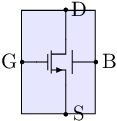
Many transistor models are available in ProMOST, including various versions of
These models are known to properly describe the intrinsic behavior of MOS transistors. This intrinsic transistor behavior typically neglects interconnect series resistances and interconnect capacitances and may neglect junctions. These bare transistor models are typically used in older (larger technology node) technologies and for model sets aiming at high simulation speed at the cost of some accuracy.
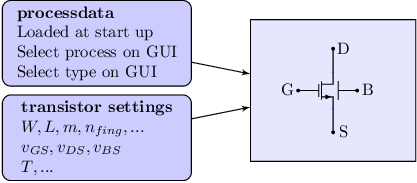
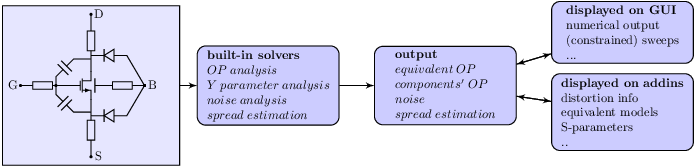
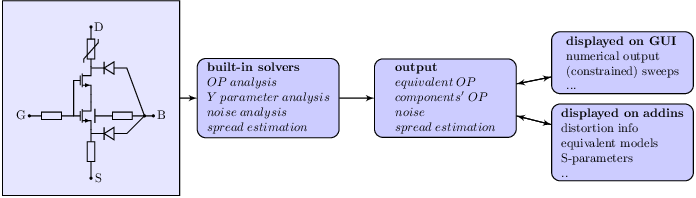
In ProMOST, transistor data can be imported after which you can select one of those transistors on the GUI. For the selected transistor, you can set the bias voltages, current, transconductance, width, length. Of these, one parameters follows from all other specified data. Other parameters you can specify include the process corner, temperature, stress parameters. A schematic overview of the input into the model is shown in Figure 4.
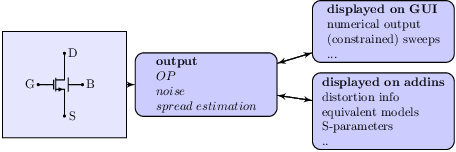
ProMOST outputs among others OP-data, small signal properties, noise, mismatch and distortion metrics. For this, an OP-analysis, noise analyses and an ac-analysis is done for the data presented on the main GUI. More detaile data on small signal behavior or on distortion is available via add ins. A representation of the data output is shown in Figure 5.
Many of nowadays transistor models actually are subcircuits consisting of at least one transistor with a number of passives and diodes wrapped around that core transistor. These passives typically model extrinsic effects such as series interconnect resistances and capacitances. These passives frequently are non linear (voltage dependent) components. In conventional (Spice-like) circuit simulators, OP data is reported for every component in the subcircuit that corresponds to the transistor symbol in your schematic entry. For the model on the left hand side in Figure 6 then the OP data for the 4 resistors, 2 capacitor, 2 diodes and for the transistor are all shown. This does, however, not report the OP behavior of the full subcircuit which is what matters in designing your circuit.
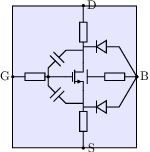
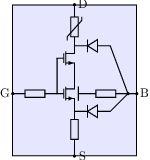
In ProMOST, the equivalent OP-data, small signal properties, noise, mismatch and distortion are by default reported for the complete subcircuit. This is done via a number of solvers that simulate the extended/compound transistor model and map its behavior on a 4-terminal equivalent. The OP-data and noise contributions for all individual instances in the compound model are of course also reported (for reference purposes).
Note that the mapping on an equivalent circuit — as done in ProMOST — means that the
reported properties of the compound transistor model correspond to the behavior of the full
instance. It also means that e.g. the small signal parameters in the OP-data for the transistor
in the compound model are not equal to those of the equivalent compound model.
As example, this subsection deals with a source-degenerated MOS transistor. Taking only the transistor’s gm, gds and Cgs into account, and assuming an extrinsic or explicit source-series resistance RS, equation can be derived that express the equivalent gm,equiv, gds,equiv and zin,equiv of the source-degenerated MOS transistor in (the small set of) transistor parameters and in RS. These equations already prove to be complex:
gm,equiv = gm ⋅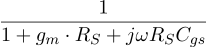 | |||
gds,equiv = gds ⋅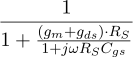 | |||
zin,equiv =  ⋅ (1 + gmRS + jωRSCgs) ⋅ (1 + gmRS + jωRSCgs) |
In these equations, the first term on the right hand sides are the values without RS. The terms on the right hand side represent the (relative) impact of the presence of the source degeneration resistor RS.
Regular simulators report gm, gds, Cgs and RS as these are properties of the individual instances in the compound transistor. The properties of the individual components in the compound model however do not reflect the behavior of the total compound transistor model. Regular simulators do not create a set of equivalent OP data for the total compound model. The equivalent behavior can be obtained only when executing dedicated simulation runs such as Y-parameter analyses and noise analyses applied to the compound transistor model.
The above example and discussion means that a designer only sees properties of instances in
the compound model that do not represent the behavior of the compound transistor model. This
can easily lead to taking or even mistaking properties of in-compound-model instances for
behavior of the total compound model hold for the full compound model. As a results, circuit
dimensioning will take — unnecessarily — more time and will require quite a lot more
optimization cycles.
ProMOST reports by default the equivalent behavior of transistors models; for the above example that means that ProMOST derives e.g. gm,equiv, gds,equiv and zin,equiv. Besides these three equivalent properties, ProMOST reports of course all equivalent OP data, all generated from background OP, ac, Y-parameter and noise simulations that work in tandem. For completeness, the OP data of all instances in the compound model are also reported, in a different data pane.